Optica 2026

Polarimetric Full-Wavefield Coherent Lidar
1 University of Toronto 2 Vector Institute 3 Ciena Corporation 4 POSTECH
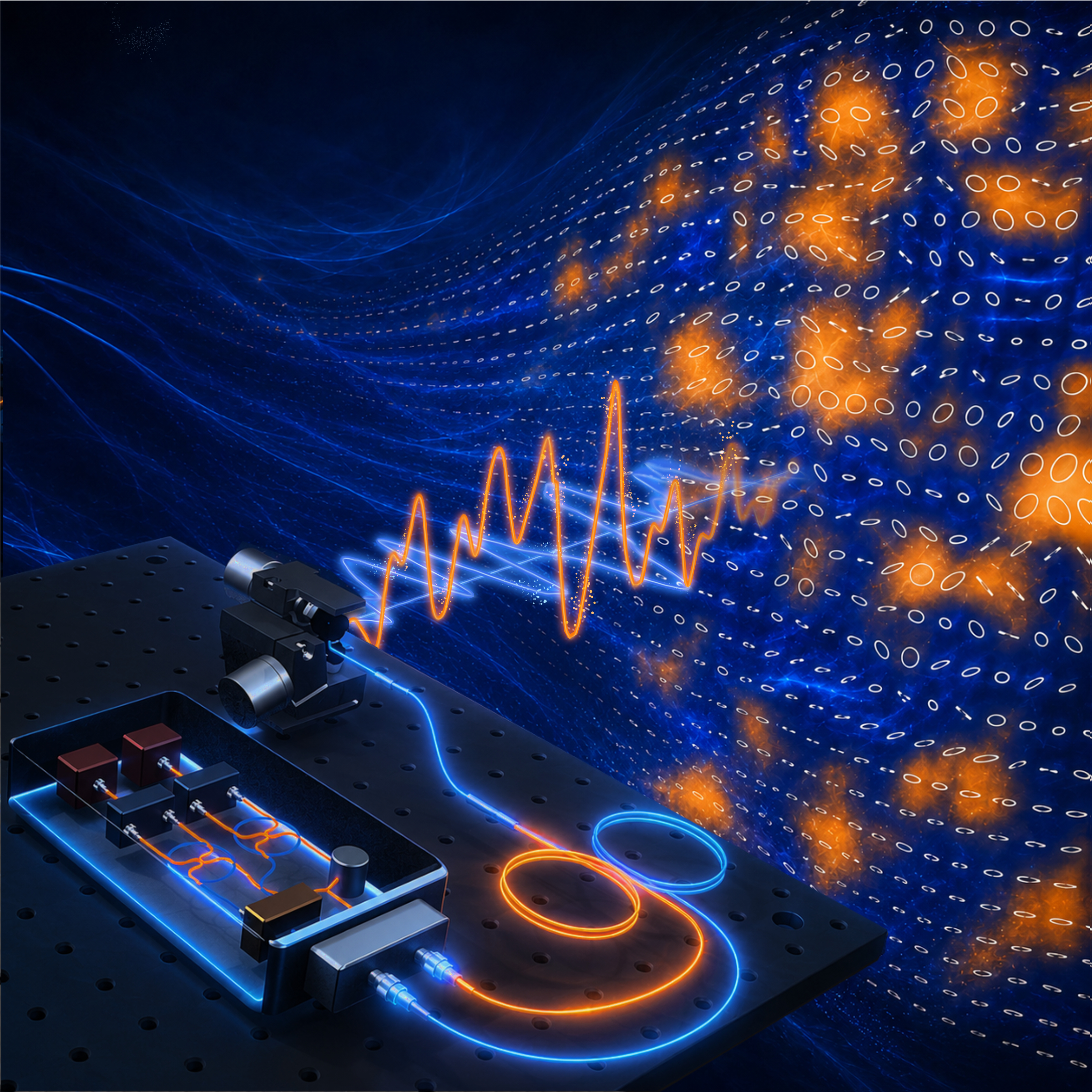
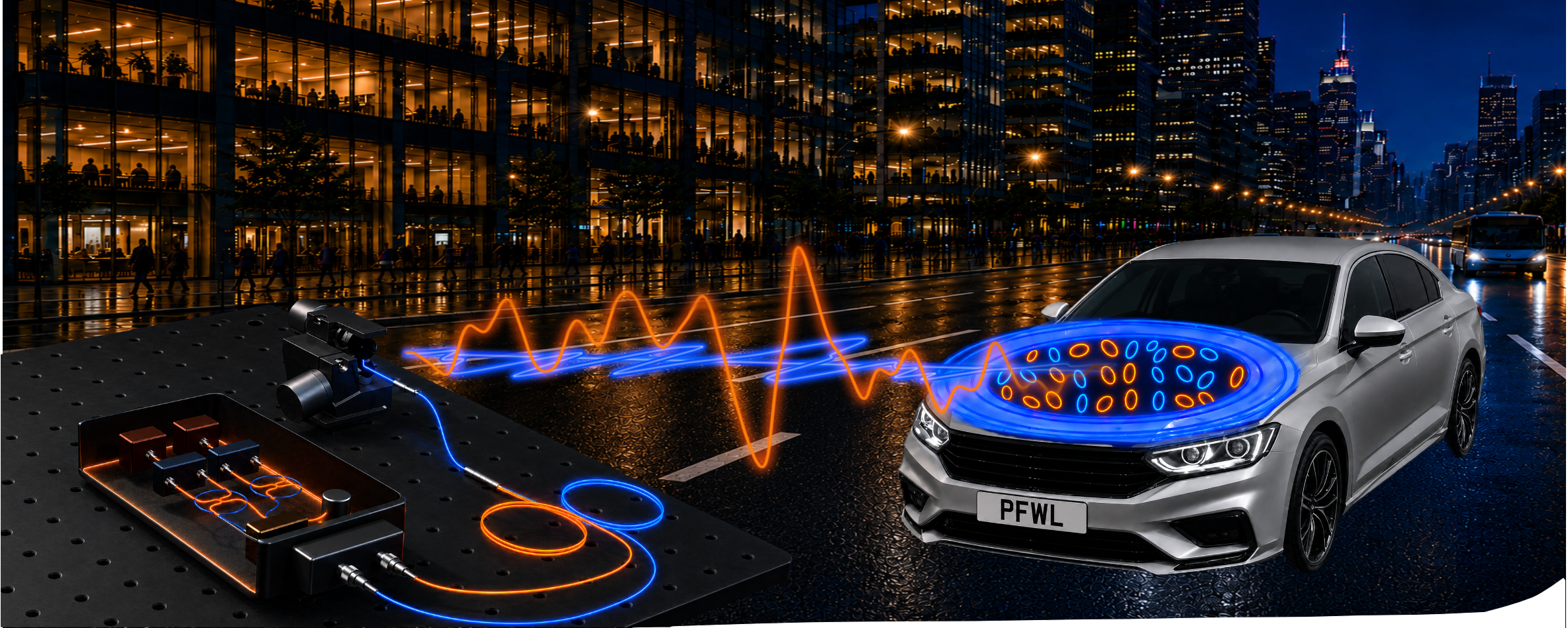
Polarimetric full-wavefield coherent lidar system illuminating a car in a night city scene.

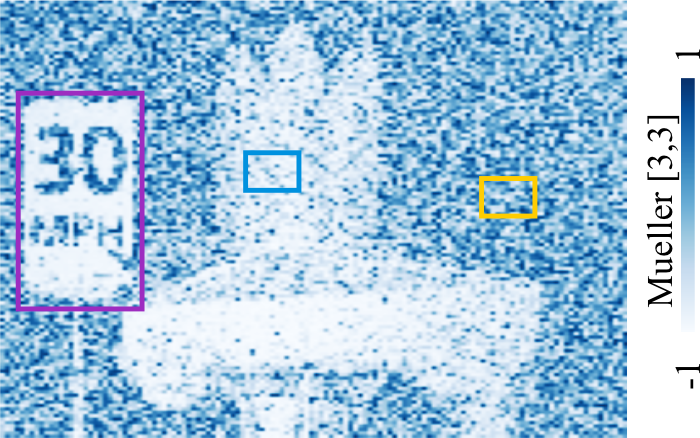
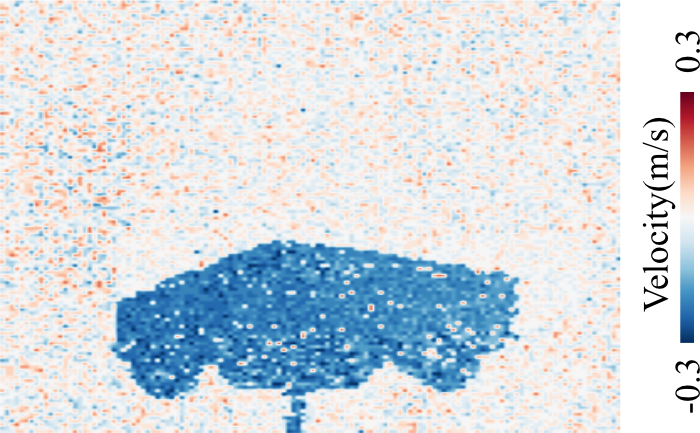
Single-measurement full-wavefield recovery

Our system simultaneously recovers a surface point's polarization, depth, and velocity, all from a single measurement.

Setup
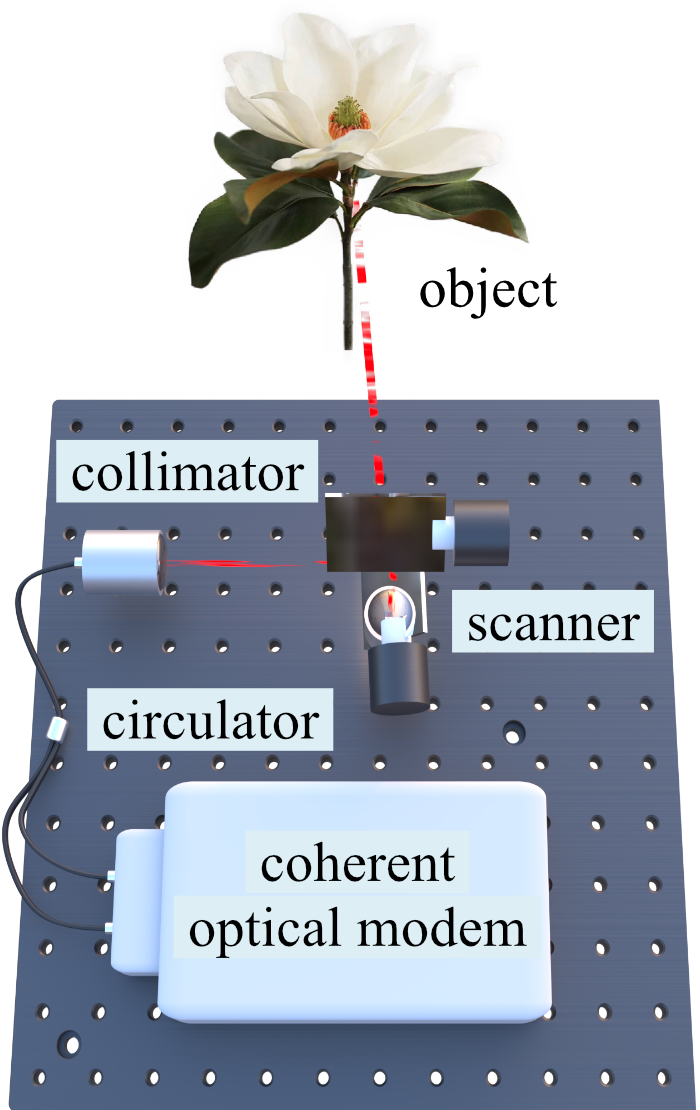
System setup
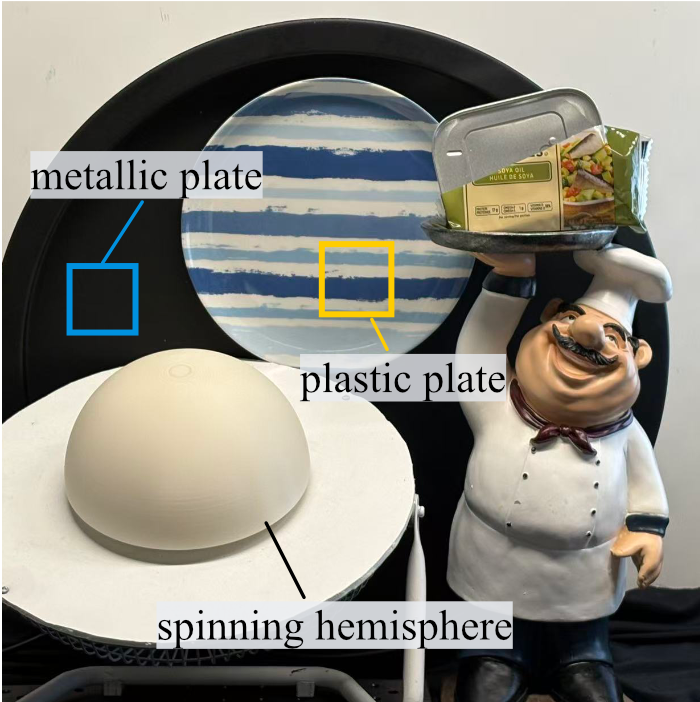
Scene
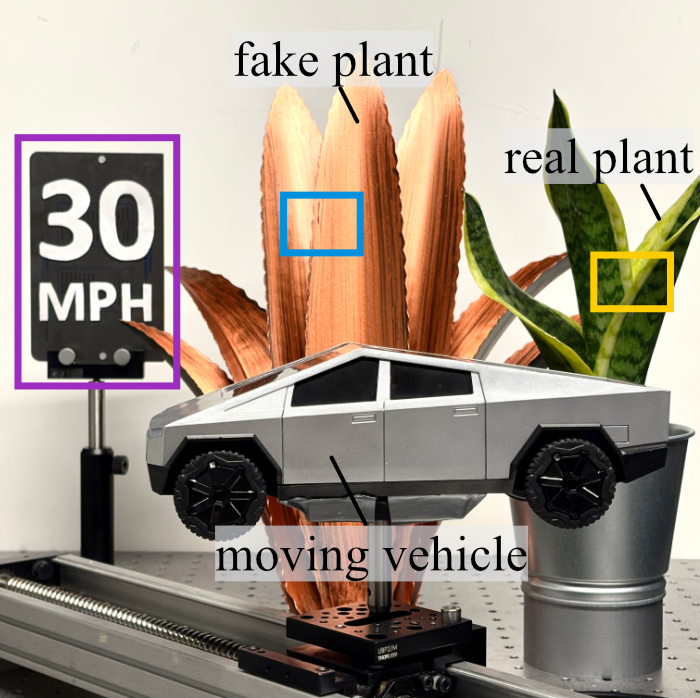
Captured scene
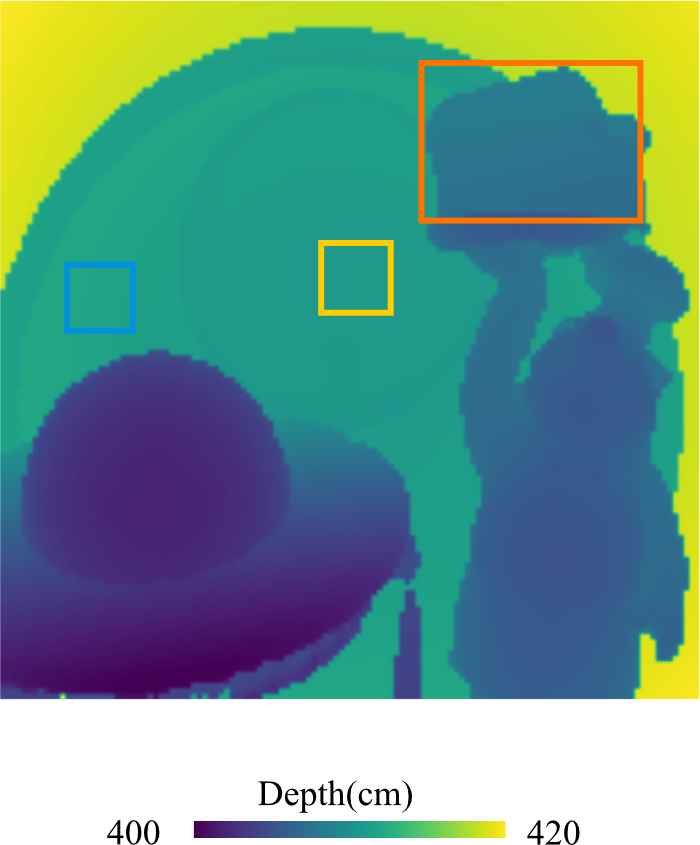
Depth
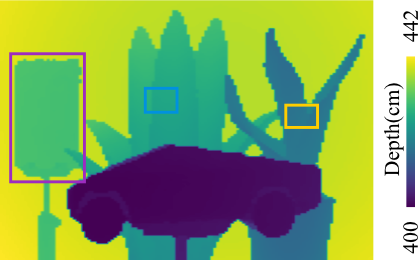
Depth map
Intensity
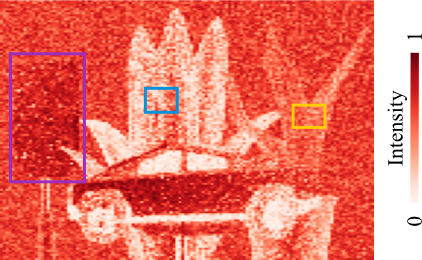
Intensity
Polarization
Polarization
Velocity
Velocity
Scene
Scene 2
Depth
Depth map
Polarization
Polarization
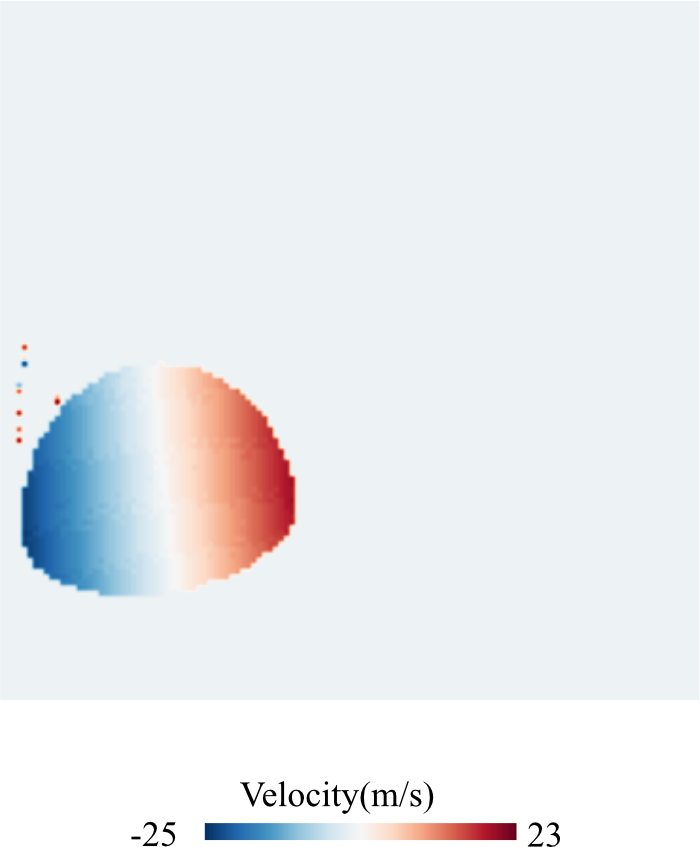
Velocity
Velocity
Millimeter-accurate depth
Robust velocimetry
Polarimetric material properties
Operates in ambient light
Eye-safe optical power

Polarimetric Coherent Measurement Model

Our system transmits a laser beam modulated by an off-the-shelf coherent optical modem through two orthogonal polarization channels. Backscattered light from the scene carries time delays \(\tau_k\) and Doppler shifts \(\nu_k\) from each surface point, along with a polarized component shaped by the surface Jones matrix \(\mathbf{J}_k\) and an unpolarized incoherent component arising from multiple micro-surface scatterers. A dual-polarization coherent receiver recovers the full optical wavefield \(\mathbf{E}_\mathrm{rx}(t)\), enabling simultaneous measurement of amplitude, phase, and polarization state. Coherent polarization speckle—arising from the interference of contributions from many micro-facets—encodes surface roughness and material properties in its statistical structure.
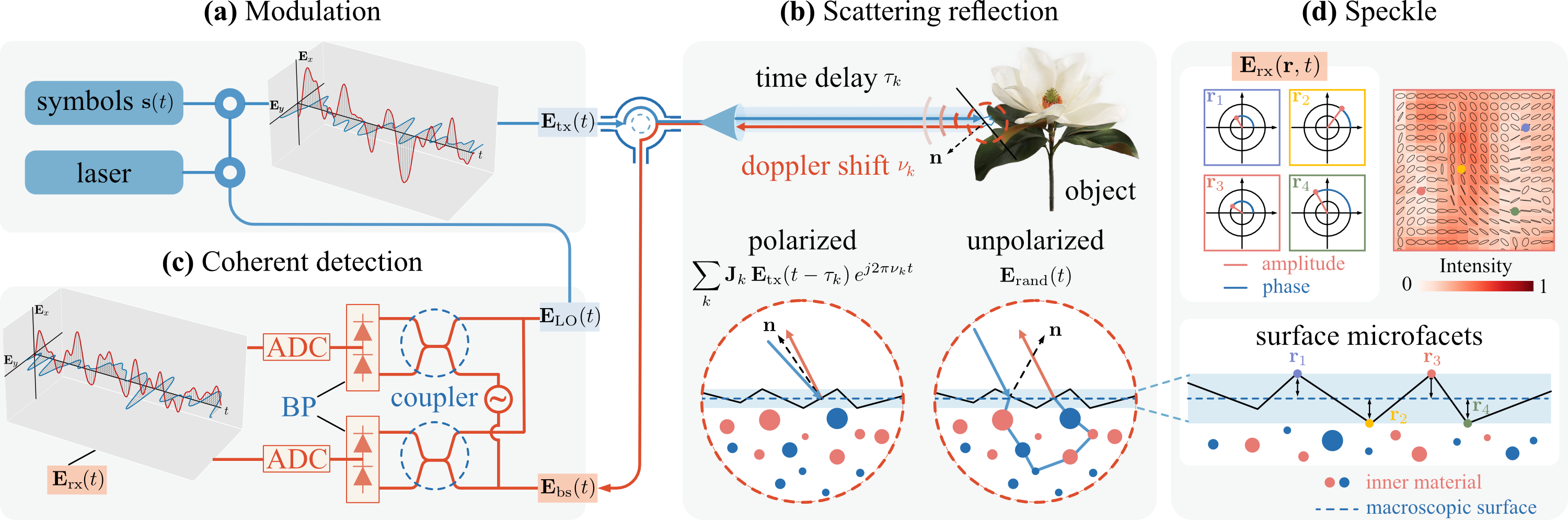
Image formation model: modulation, scattering reflection, coherent detection, and speckle.
Polarimetric coherent measurement model. (a) The baseband waveform \(\mathbf{s}(t)\) modulates the laser to synthesize a dual-polarization optical field \(\mathbf{E}_{\mathrm{tx}}(t)\). (b) The received field is a superposition of time-delayed (\(\tau_k\)) and Doppler-shifted (\(\nu_k\)) polarized echoes, together with a randomly polarized component \(\mathbf{E}_{\mathrm{rand}}(t)\) arising from multiple scattering. (c) The returned signal \(\mathbf{E}_{\mathrm{bs}}(t)\) interferes with a local oscillator \(\mathbf{E}_{\mathrm{LO}}(t)\) in a balanced receiver; bandpass filtering and analog-to-digital (ADC) sampling yield complex baseband measurements \(\mathbf{E}_{\mathrm{rx}}(t)\) in two polarization channels. (d) The measured field \(\mathbf{E}_{\mathrm{rx}}(\mathbf{r},t)\) varies across spatial locations \(\mathbf{r}\) due to coherent interference among surface microfacets, resulting in intensity and polarization speckle.

Scene Reconstruction

We formulate per-pixel reconstruction as a maximum-likelihood estimation problem. The received two-channel field \(\mathbf{E}_\mathrm{rx}(t)\) is modeled as a complex Gaussian random process whose mean is the sum of time-delayed, Doppler-shifted, Jones-matrix-transformed transmit symbols, and whose covariance is determined by the heterodyne noise and incoherent power \(\beta\). We discretize the Doppler axis onto a fixed grid and jointly estimate a depth–velocity Jones response volume \(\{\mathbf{J}_{k,m}\}\) by minimizing the negative log-likelihood with a sparsity-promoting regularization term. Depth is recovered by integrating the Jones energy \(\|\mathbf{J}_{k,m}\|_F^2\) over Doppler to find the peak-energy delay index \(k^\star\), and velocity is obtained from the dominant Doppler bin \(m^\star\) at that depth. The per-pixel Jones matrix is then decoupled from system distortions via calibrated transmit and receive Jones operators to yield the surface Jones matrix \(\mathbf{J}_\mathrm{surf}\).
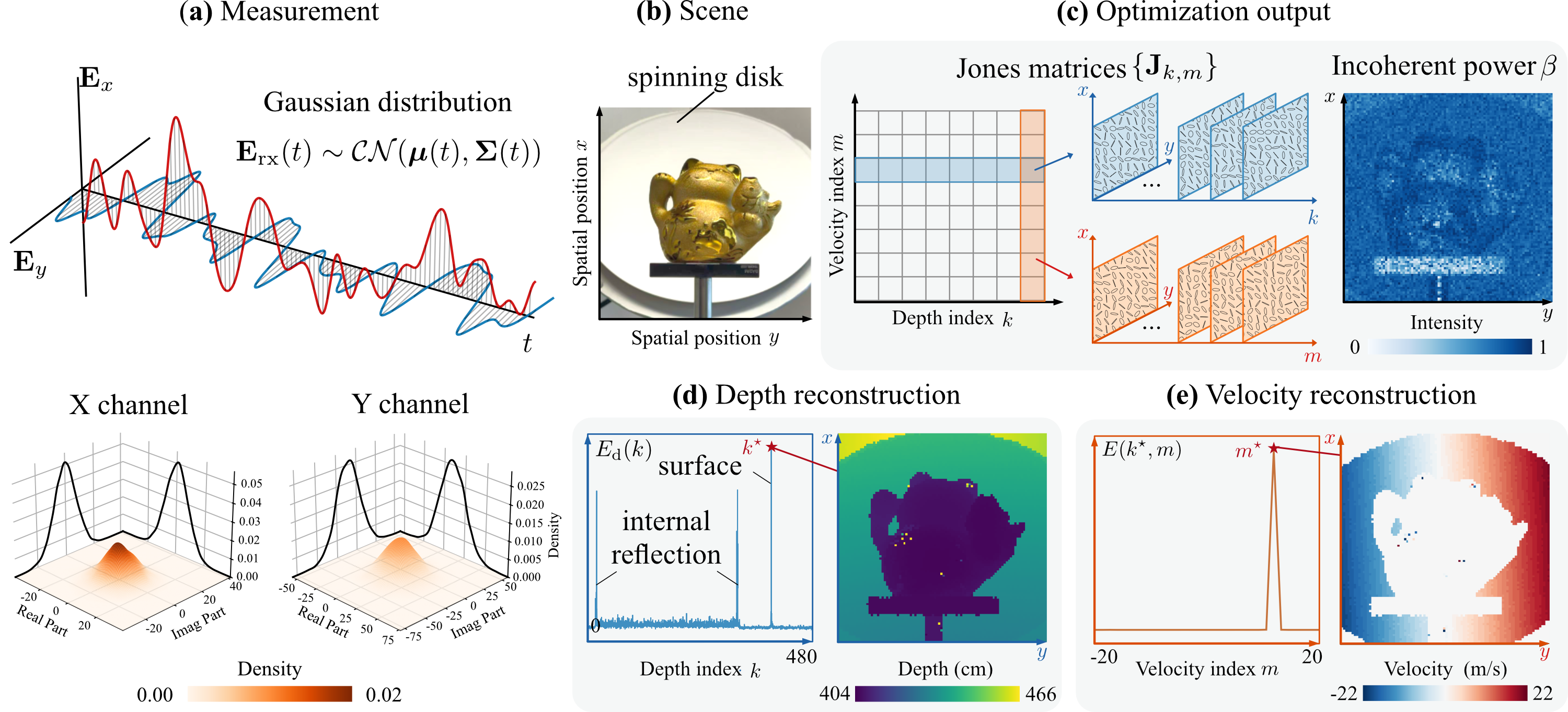
Reconstruction overview: measurement model, optimization, depth and velocity reconstruction.
Scene reconstruction overview. (a) The two-channel measurement \(\mathbf{E}_{\mathrm{rx}}(t)\) is modeled as a complex Gaussian random process; the bottom plots show the empirical complex-Gaussian densities of the \(X\) and \(Y\) polarization channels. (b) Example scene capture (a spinning disk and a figurine) scanned over spatial coordinates \((i,j)\). (c) We estimate per-pixel, depth–Doppler-indexed Jones matrices \(\{\mathbf{J}_{k,m}\}\) together with an incoherent power \(\beta\) by minimizing the negative log-likelihood. (d) We compute the measurement energy using the Frobenius norm of the Jones matrix, \(E(k,m)=\|\mathbf{J}_{k,m}\|_F^2\), integrate over Doppler to obtain the depth profile \(E_{\mathrm{d}}(k)\), and estimate depth as \(k^\star=\arg\max_k E_{\mathrm{d}}(k)\). (e) We obtain velocity by identifying the dominant Doppler index \(m^\star=\arg\max_m E(k^\star,m)\).

Reconstruction under Ambient Light

Coherent detection enables accurate depth and polarization recovery despite strong, spatially-varying ambient illumination.
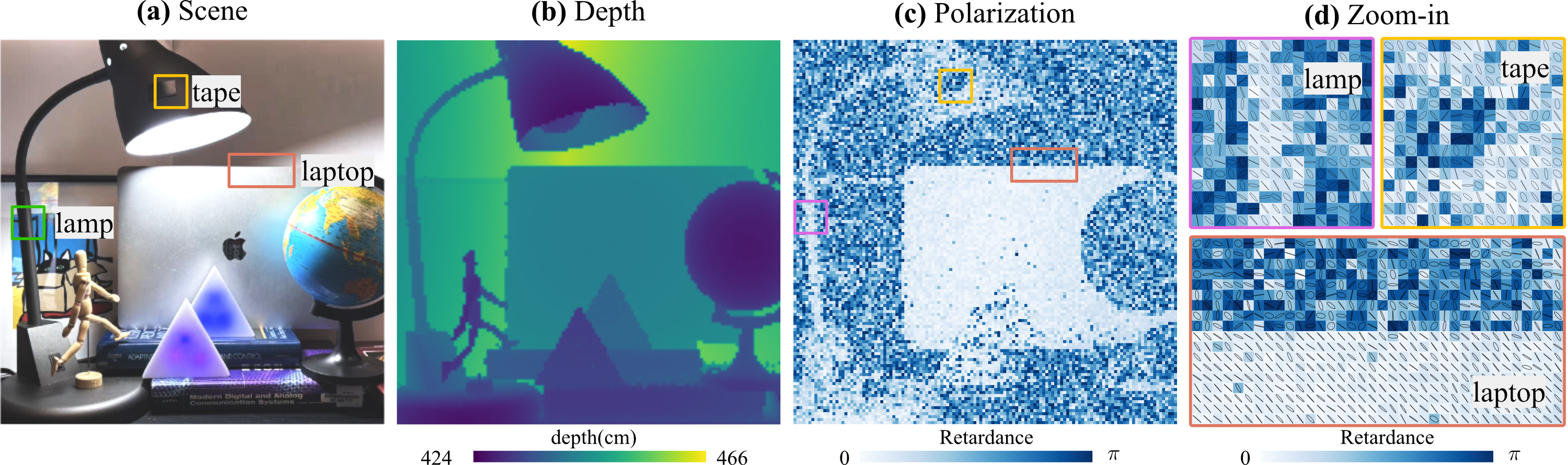
Reconstruction under strong ambient light.
Reconstruction under strong ambient light. (a) A tabletop scene is lit by multiple uncontrolled sources (desk lamp, ceiling light, triangular-shaped blue and purple LEDs), creating strong spatially-varying background light. (b) Despite the presence of ambient light, coherent detection enables robust depth recovery with clear object geometry. (c) The reconstructed polarimetric response remains accurate under ambient illumination. (d) The zoomed-in insets reveal metallic–dielectric differences in both retardance and the overlaid Jones ellipse features (orientation and ellipticity), comparing the lamp arm/head and laptop with the background paper and tape.

Polarization Coherent Speckle Reconstruction

Polarization-resolved coherent speckle reveals material-dependent scattering signatures invisible to intensity-only measurements.
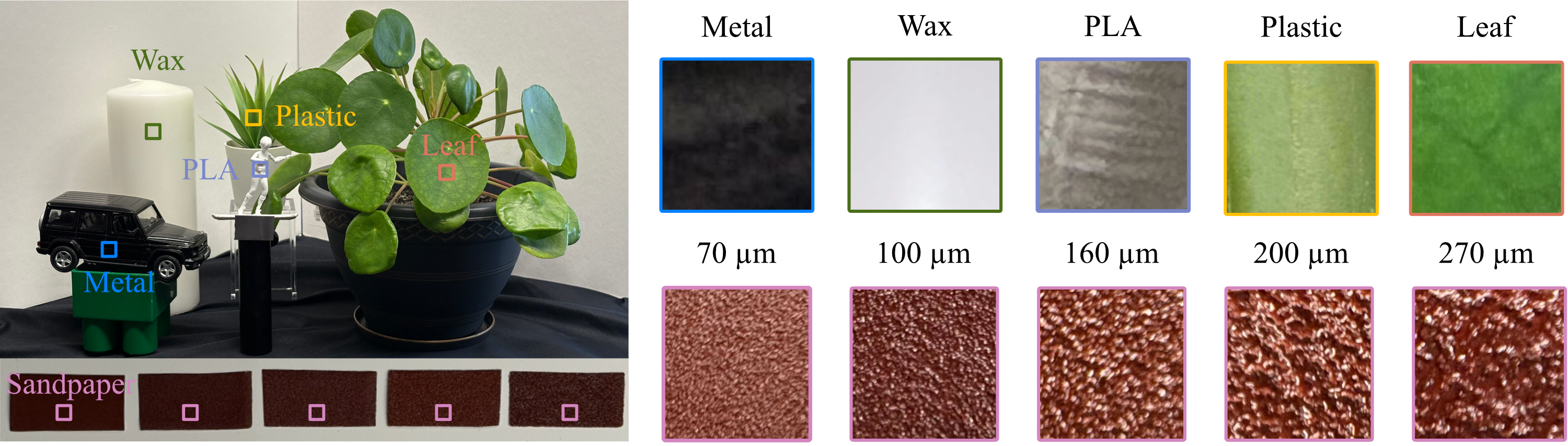
Polarization speckle overview.
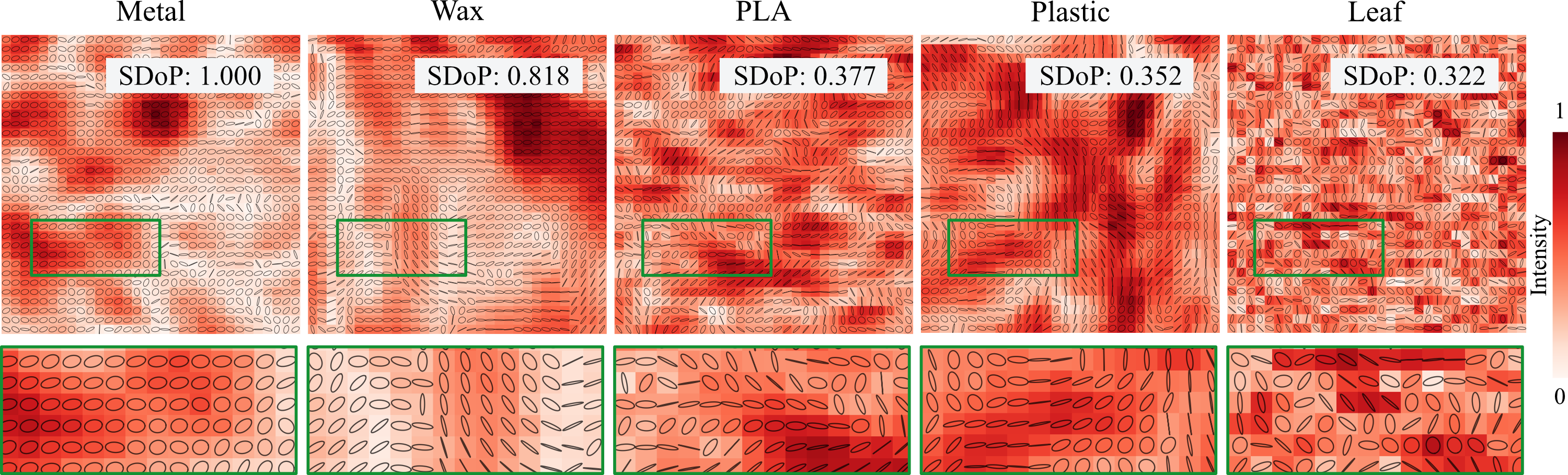
Polarization speckle from different materials.
Polarization speckle for five representative materials (metal, wax, PLA, plastic, and leaf). Reconstructed intensity speckle overlaid with polarization ellipses over an approximately 2 mm by 2 mm scan. The SDoP decreases from metal to translucent wax and dielectric PLA/plastic due to increasing subsurface scattering that progressively randomizes polarization. The real leaf exhibits highly random polarization states due to multiple scattering within complex biological microstructures.
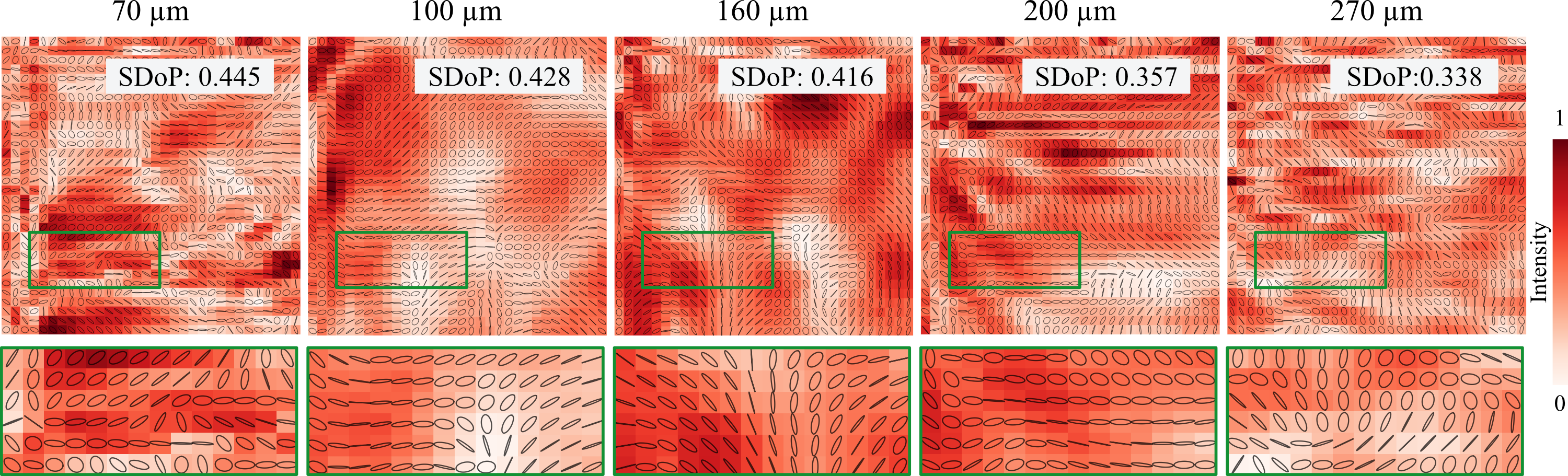
Polarization speckle from sandpaper samples of varying roughness.
Polarization speckle for sandpaper samples of varying surface roughness (70–270 μm grain size). Reconstructed intensity speckle overlaid with polarization ellipses over an approximately 2 mm by 2 mm scan. SDoP decreases monotonically as surface roughness increases, indicating stronger depolarization and higher speckle randomness.

Imaging Through a Scattering Layer

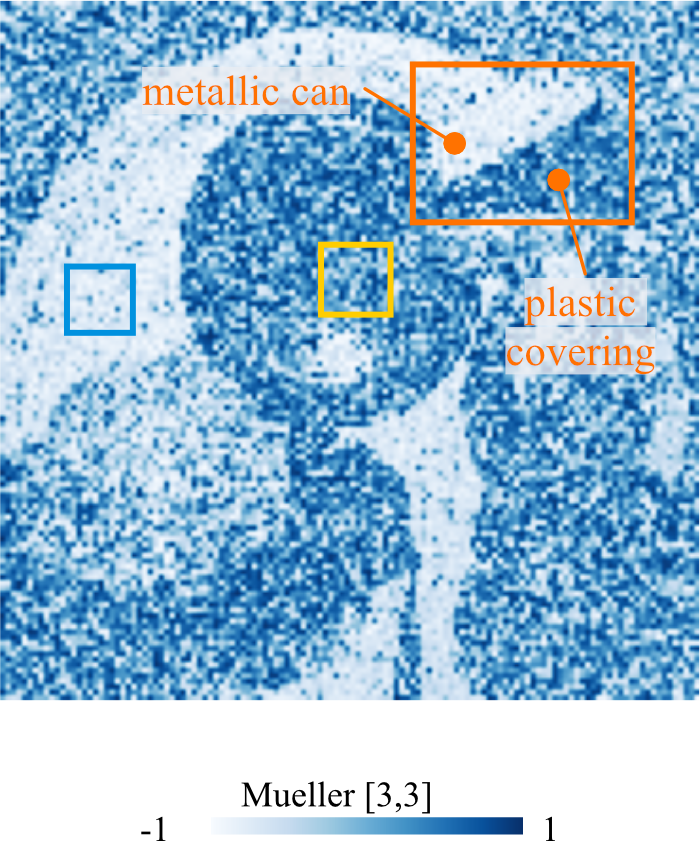
Polarimetric features enable reliable material discrimination through diffuse scattering, where intensity alone provides insufficient contrast.
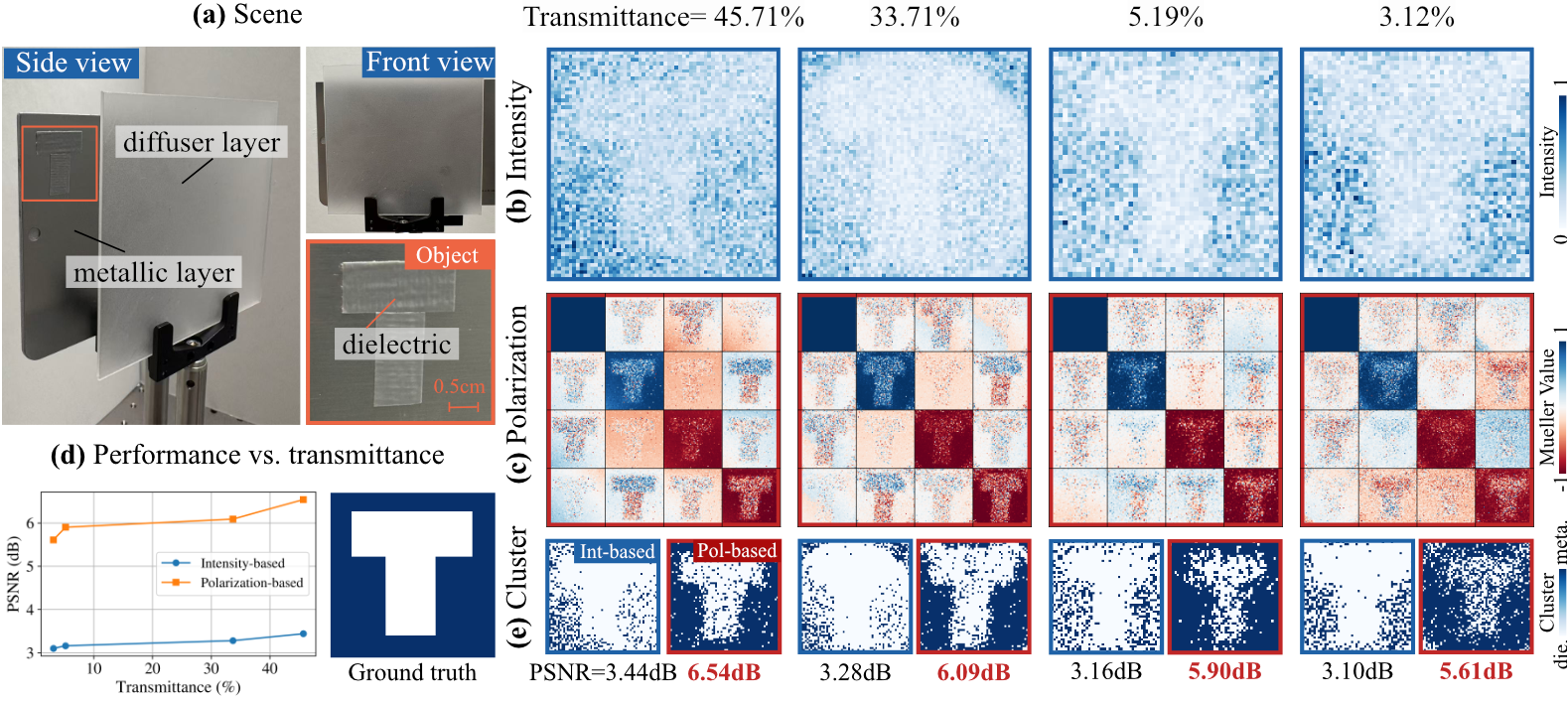
Imaging through thin diffuser layers.
Imaging through thin diffuser layers. Diffuser layers with different grit levels (Thorlabs DG20-1500, DG10-600, DG20-220, and DG10-120). For each medium, (a) experimental configuration, (b) intensity reconstructions, (c) reconstructed Mueller-matrix responses, (d) PSNR as a function of measured in-aperture transmittance, and (e) material clustering using intensity-based and polarization-based features.
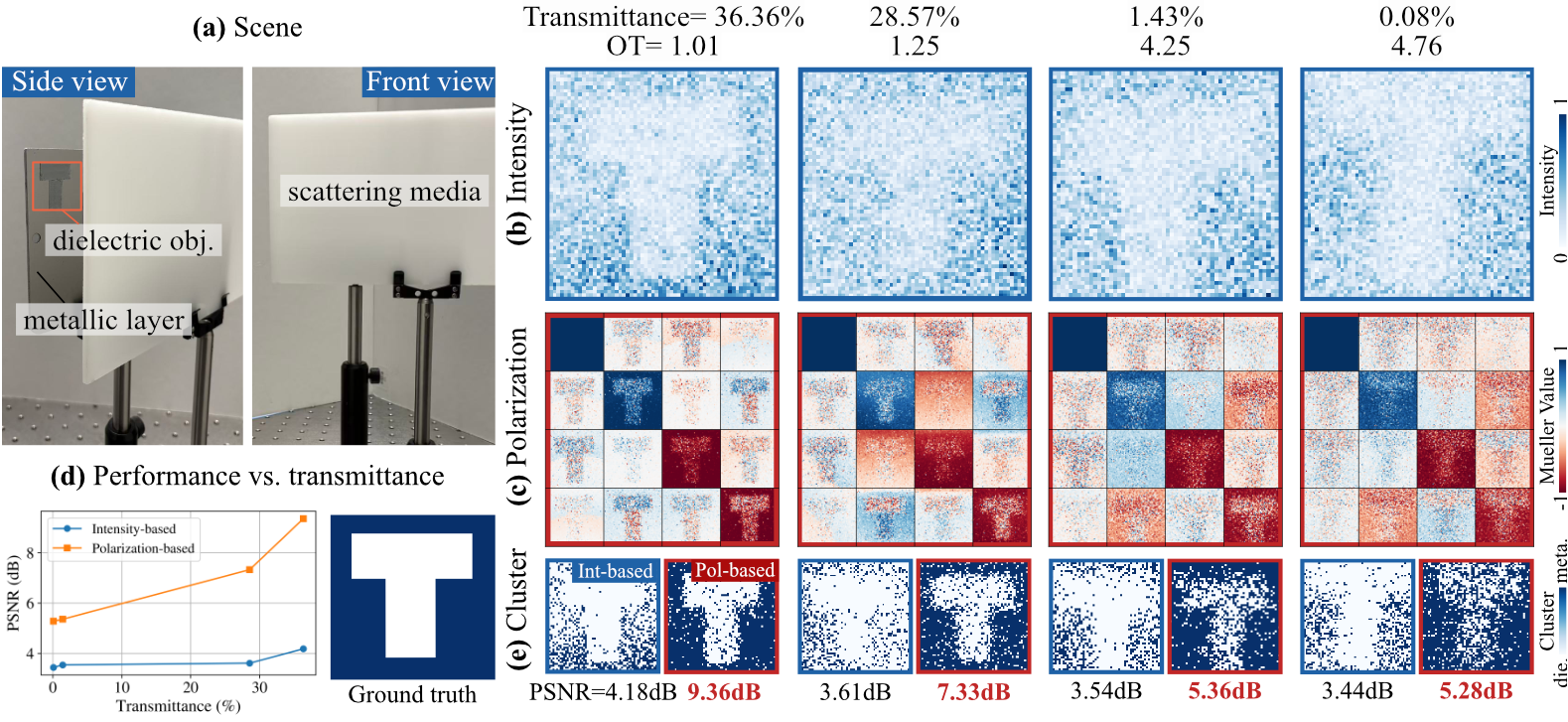
Imaging through PMMA acrylic slabs.
Imaging through PMMA acrylic slabs. Slabs with different thicknesses (1, 1.5, 2, and 3 mm). For each medium, (a) experimental configuration, (b) intensity reconstructions, (c) reconstructed Mueller-matrix responses, (d) PSNR as a function of measured in-aperture transmittance, and (e) material clustering using intensity-based and polarization-based features.

BibTeX

@article{du2026polarimetric,
  title     = {Polarimetric Full-Wavefield Coherent Lidar},
  author    = {Du, Dongyu and Xie, Andrew and Mirdehghan, Parsa and Buscaino, Brandon
               and Baek, Seung-Hwan and Kutulakos, Kiriakos N. and Lindell, David B.},
  journal   = {Optica},
  year      = {2026},
  publisher = {Optica Publishing Group}
}